The Budget and Health Care
 Governor Pawlenty has missed an important opportunity in the recently released budget for the upcoming biennium. This budget relies heavily on one time money to pay for ongoing expenses, contributing to a significant structural imbalance. The budget hits health care programs especially hard.
The Governor’s budget removes 113,000 people from state health care programs through FY11 just as layoffs are increasing and jobs become scarce. Even more people stand to lose health care if the Governor’s provider payment cuts reduce access and curtail prevention efforts. The budget eliminates dental, chiropractic, podiatry, and rehabilitation services for our most vulnerable adults. It also eliminates all MnCare coverage for adults without children.
The Health Care Access Fund is gutted as the plan transfers these dollars to the general fund. However, the tax paid by providers, our medical and dental professionals, and social workers will remain. When the tax dollars went to the underinsured or underserved, there was some buy-in by our health care professionals. Where is the incentive to pay into the Fund now?
Furthermore, cuts to health care jeopardize federal stimulus money with its Medical Assistance (MA) eligibility cuts. In addition, state dollars help leverage federal matching funds. Failure to provide state dollars means additional cuts to health care. Those responsibilities will be passed on to property taxpayers, increasing burdens on county governments, nonprofits, and hospitals.
We need long term solutions to this budget crisis. Fiscal responsibility, without making our health care problems worse, should be at the forefront of the budget discussion.
 Today Governor Pawlenty revealed his budget proposal for the 2010-11 biennium. Over the next few days, weeks, and months, the legislature and the public will have a chance to look it over and weigh in on the good, the bad, and the ugly. This is the job of the Minnesota legislature. We will take a look at the Governor’s proposals and gather input on these and other proposals brought forth by Senators, Representatives, and citizens like you.
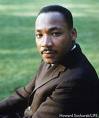 On Monday, January 19, we celebrate the life of Rev. Dr. Martin Luther King, Jr. Fittingly, the following day, we will celebrate the inauguration of the first African American President of the United States, Barack Obama. The following excerpt was taken from an article which appeared in the New American Review, January 1969, and written by Pat Watters. He had been to the Poor People’s March in Washington D.C. the week after MLK’s death. He penned his thoughts on his return to Georgia…
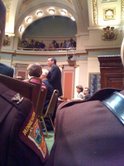 At about 11:40am today, the Minnesota Senate lined up outside the Senate Chambers, ready to proceed down the hall to the Minnesota House of Representatives. At 11:45, after being introduced by the Sergeant-of-Arms, we entered the chamber amid applause from our legislative colleagues. As we walked down the main aisle, we shook hands and exchanged pleasantries to those House members within reach. We took our own seats and awaited the arrival of the Governor. The Supreme Court Justices were introduced and welcomed with a standing ovation….followed by the constitutional officers, Secretary of State Mark Ritchie, Attorney General Lori Swanson, and Auditor Rebecca Otto. The Lieutenant Governor, Carol Molnau, was escorted to her seat. The lone former Governor in attendance, Al Quie, was introduced and given a warm reception as he took a chair in the front row.
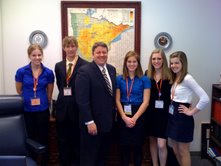 This past weekend, Minnesota YMCA Youth in Government (YIG) took over the Capitol building. Minnesota YIG is a youth-led, experiential learning opportunity that involves 1,800 middle-school and high school students each year. It is a nation-wide program, active in nearly 40 states. Across the country almost 25,000 students attend state Youth in Government conferences each year, with 3,300 adult volunteers and YMCA staff serving as advisors. So what did our young people do for the last four days?
 One of the first bills to be introduced in the Minnesota Senate this week will be a bill to maximize the Federal Stimulus package being developed in Washington, D.C. The conventional wisdom is that such a program will include components targeted to both individuals and states. By all indications, the objective of the incoming administration and Congress is to identify programs that can be implemented quickly and provide economic stimulus for an extended period. For Minnesota, infrastructure investment, especially for “ready to go” projects would be given a high priority. Support for Medicaid and other grant programs through an increase in federal medical assistance might also be a high priority. It is commonly believed that any stimulus package would include the following considerations:
 : Maintain a normal private life. Enjoy time with family and friends. Take time for myself.